Nikolay Rimsky-Korsakov
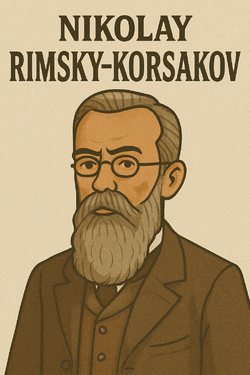
Russian composer, conductor, and music educator, a central figure of the Russian nationalist group 'The Five' and a master of orchestration.
Born into a noble family near Tikhvin, Rimsky-Korsakov initially pursued a career in the Imperial Russian Navy, graduating from the Sea Cadet Corps in 1862 and undertaking a world cruise (1862-1865). While a naval officer, he composed his First Symphony. Largely self-taught in composition initially, he became a professor at the Saint Petersburg Conservatory in 1871, teaching himself harmony and counterpoint rigorously to qualify. He was a key member of 'The Mighty Handful' (The Five), alongside Balakirev, Borodin, Cui, and Mussorgsky. He later served as Inspector of Naval Bands (1873-1884), conductor of Russian Symphony Concerts (from 1886), and assistant director of the Imperial Chapel (1883-1894). He revised and completed works by Borodin and Mussorgsky. His own prolific output includes 15 operas (e.g., 'The Snow Maiden', 'Sadko', 'The Golden Cockerel'), symphonic works (e.g., 'Scheherazade', 'Capriccio Espagnol'), chamber music, songs, and a significant treatise on orchestration. He taught prominent composers like Glazunov, Stravinsky, and Prokofiev.
- Despite having almost no formal compositional training, Rimsky-Korsakov was appointed Professor of Practical Composition and Instrumentation at the Saint Petersburg Conservatory in 1871 at age 27. He famously taught himself the subjects he was assigned overnight, later stating he was 'perhaps the best pupil' of his own classes during that period.
- Rimsky-Korsakov faced political controversy in 1905. He publicly supported students protesting against the Tsarist government's actions, leading to his dismissal from the Conservatory faculty. This sparked resignations in solidarity from Glazunov and Lyadov. He was reinstated only after the Conservatory gained autonomy later that year.
- Rimsky-Korsakov suffered from angina in his later years. His death in 1908 is often attributed to a heart attack, reportedly brought on by an intense argument with his daughter's suitor, Maximilian Steinberg (who later married her and became a composer/conservatory professor himself), over the suitor's political views.