Daft Punk: The Robots Who Revolutionized Electronic Music
Who Were Daft Punk?
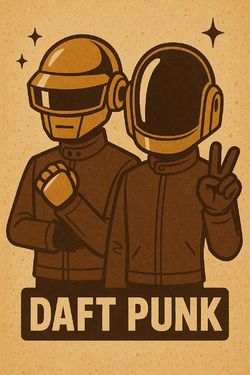
Daft Punk was a revolutionary French electronic music duo formed in Paris in 1993 by Thomas Bangalter and Guy-Manuel de Homem-Christo. Rising from the underground rave scene, they became global icons by merging house, funk, and disco into a groundbreaking sound. Their most distinctive feature was their decision to conceal their faces entirely, adopting robot personas with elaborate helmets and gloves during all public appearances and performances.
The Mystery Behind the Helmets
After a studio accident damaged their equipment in 1999, Bangalter and de Homem-Christo embraced anonymity, commissioning custom helmets from designer Tony Gardner and his company Alterian Inc. These iconic headpieces—featuring LED displays, gold plating, and intricate details—became central to Daft Punk's identity. The helmets evolved over time, including Guy-Manuel's gold visor and Thomas's silver chrome design, symbolizing their transformation into 'robots' dedicated purely to music.
Musical Breakthroughs and Legacy
Daft Punk reshaped electronic music with albums like 'Homework' (1997), 'Discovery' (2001), and the Grammy-winning 'Random Access Memories' (2013). Hits such as 'Around the World,' 'One More Time,' and 'Get Lucky' (featuring Pharrell Williams) dominated charts worldwide. 'Get Lucky' celebrated joy and serendipity in dance culture, while 'Instant Crush' was co-written with Julian Casablancas of The Strokes. Their innovative visuals, including the anime film 'Interstella 5555,' cemented their status as futurist pioneers.
What Happened to Daft Punk?
In February 2021, Daft Punk announced their breakup via an 8-minute video titled 'Epilogue,' showing one robot self-destructing. No explicit reason was given, but band members later hinted at a desire to end on a high note after 28 years. Their final work was collaborating with The Weeknd on 'Starboy' (2016). The split sent shockwaves through the music world, with fans mourning the end of an era defined by innovation and mystery.
- The helmets required teams of engineers to operate; Thomas Bangalter's chrome helmet weighed over 5 pounds and had a cooling system to prevent overheating during performances.
- Their breakup video 'Epilogue' referenced a scene from their 2006 film 'Electroma,' symbolizing artistic closure. Many fans speculated health issues or creative differences, but neither was confirmed.
- Daft Punk almost revealed their faces for a 2013 'Rolling Stone' cover but used illustrated robots instead, maintaining secrecy until their dissolution.