
Carlos Gardel Biography
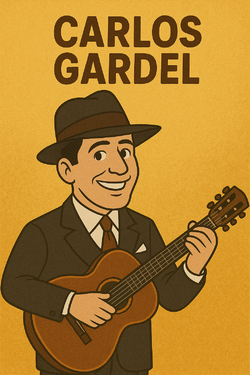
Carlos Gardel was an internationally renowned singer, songwriter, and actor, celebrated as the most prominent figure in the history of the tango. Revered as 'El Zorzal Criollo' (The Creole Thrush) and 'El Mago' (The Magician), he is considered the 'King of Tango'.
Born in France, Gardel moved to Buenos Aires as a young child. He began his career singing in bars and parties, gaining fame in the 1910s. He revolutionized tango by transforming it from an instrumental dance form into a vehicle for poignant sung poetry. His prolific recording career, film appearances, and international tours made him a massive star throughout Latin America, Europe, and the United States. His life was tragically cut short in a plane crash in Medellín, Colombia, at the height of his fame.
- Gardel's exact birthplace is a subject of enduring controversy. While he claimed Uruguayan birth (Tacuarembó), overwhelming historical evidence, including a French birth certificate, confirms he was born in Toulouse, France. This discrepancy fueled nationalistic debates in Argentina and Uruguay.
- He achieved immense popularity not only through his recordings but also through pioneering roles in early 'talkie' films for Paramount Pictures, produced in France and the US, which were hugely successful in Spanish-speaking markets.
- Gardel died tragically on June 24, 1935, in Medellín, Colombia, when the airplane he was traveling aboard collided with another plane on the runway during takeoff. The crash killed him, his lyricist Alfredo Le Pera, several members of his musical entourage, and the crew.
- His death triggered an unprecedented outpouring of grief across Latin America. His funeral procession in Buenos Aires drew massive crowds. To this day, devotees visit his grave in La Chacarita Cemetery, often lighting a cigarette left in the hand of his statue, perpetuating the saying 'Gardel sings better every day'.
- His legacy is monumental. Songs like 'Mi Buenos Aires Querido', 'Por una Cabeza', 'El día que me quieras', and 'Volver' remain tango standards. He is an enduring cultural icon, symbolizing the golden age of tango.
