
Equal Temperament Tuning: Nature, Cause, and Effect
Equal temperament tuning is a pitch organization system in which the octave is defined by a precise 2:1 frequency ratio. Once the octave is established, it is subdivided into equal intervals. In modern Western music, the octave is most commonly divided into twelve equal semitones, forming the foundation of contemporary harmonic and melodic practice.
By halving a fundamental frequency, the resulting tone produces the first natural harmonic overtone. Beyond this octave relationship, equal temperament deliberately simplifies the complex structure of natural overtones in order to achieve consistent interval spacing. This compromise enables reliable transposition, modulation, and uniformity across instruments.
Earlier tuning frameworks, including systems derived from the cycle of fifths, relied on simple numerical ratios. These approaches preserved strong acoustic relationships but introduced inconsistencies across distant key centers. Equal temperament resolved these limitations by distributing small tuning discrepancies evenly throughout the scale.
Natural Harmonics and Overtone Structures
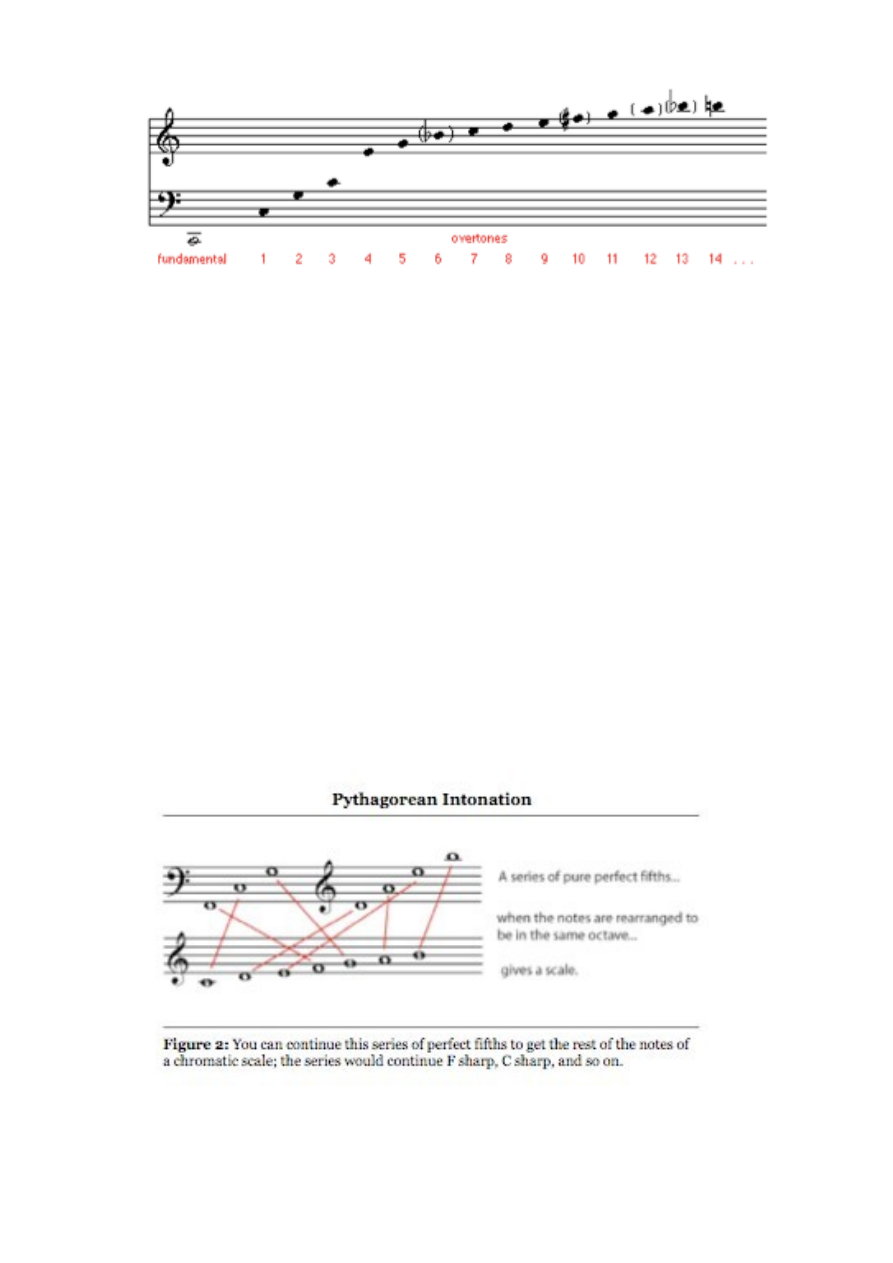
All pitched sounds originate from vibration. A vibrating string or air column generates a fundamental frequency accompanied by a series of harmonics. These overtones occur at mathematically predictable ratios and shape timbre, resonance, and perceived tonal color.
The harmonic series does not align perfectly with equal-tempered pitch divisions. While octaves and fifths emerge as highly stable relationships, other intervals display subtle deviations. As harmonic density increases, pitches become progressively closer together, producing a continuous gradient rather than discrete equal steps.
Because each overtone series contains unique interval spacing, strictly equal partitions represent an acoustically simplified model. Equal temperament therefore functions as a practical standard rather than a direct reflection of natural resonance patterns.
Pythagorean Tuning and the Comma Phenomenon
Interval construction based on successive perfect fifths yields a coherent tonal network but introduces a measurable discrepancy. After completing twelve fifth cycles, the resulting pitch does not perfectly coincide with the expected octave alignment. This deviation is known as the Pythagorean comma.
The comma illustrates a fundamental constraint of ratio-based tuning systems: pure intervals cannot be extended indefinitely without accumulating slight inconsistencies. These mismatches historically produced the so-called “wolf” interval — a noticeably unstable sonority.
Development of Tempered Tuning Systems
Tempered tuning strategies emerged to balance acoustic purity with functional flexibility. Mean-tone and well-tempered systems redistributed tuning adjustments to improve usability across multiple keys. Each approach represented a different optimization between consonance and versatility.
Equal temperament ultimately standardized this process by evenly allocating all tuning deviations. The result enabled unrestricted modulation, consistent chord structures, and stable pitch relationships across large instrumental ranges.
Renaissance Innovation and Harmonic Expansion
Advances in instrument design and musical notation accelerated harmonic experimentation. Polyphonic writing expanded from two and three voices toward richer multi-part textures. Thirds and sixths gained prominence, reshaping tonal perception and compositional practice.
As harmonic language evolved, tuning systems required greater adaptability. The increasing demand for modulation and ensemble compatibility reinforced the practical advantages of tempered tuning models.
Instrument Technology and Standardization
The refinement of keyboard instruments intensified the need for uniform pitch distribution. Earlier temperaments reduced extreme dissonances but retained localized irregularities. Equal temperament provided a scalable solution compatible with expanding tonal architecture.
Although certain harmonic nuances inherent in natural ratios were moderated, the system delivered unprecedented structural consistency. This stability supported large ensembles, orchestration, and complex tonal planning.
Perceptual and Aesthetic Considerations
Debate surrounding tuning systems frequently contrasts acoustic purity with musical functionality. Natural interval relationships emphasize resonance and tonal color, whereas equal temperament prioritizes coherence across all keys.
Modern listening habits often normalize equal-tempered sonorities. Nevertheless, comparative analysis reveals distinct differences in beating patterns, harmonic tension, and tonal shading between tuning frameworks.
Exploration of Harmonic Possibilities
Investigation of alternative tuning approaches continues to inform composition, performance, and sound design. Systems based on natural ratios highlight the expressive potential of harmonic identity and spectral relationships.
Understanding the interaction between vibration, perception, and mathematical structure deepens insight into tonal organization. Whether employing equal temperament or ratio-based models, tuning remains a central determinant of musical character.