Jacques Offenbach: Master of Operetta
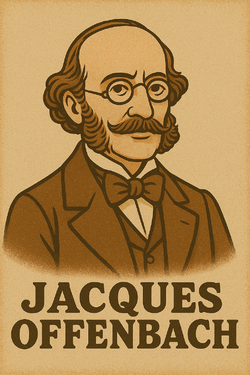
German-born French composer and cellist, celebrated as the 'father of the operetta' for revolutionizing light musical theatre in 19th-century Paris.
Born in Cologne, Offenbach studied cello in Paris, becoming a renowned virtuoso and conductor. He founded the Théâtre des Bouffes-Parisiens (1855), composing nearly 100 stage works, primarily sparkling, satirical operettas like 'Orpheus in the Underworld' and 'La Belle Hélène'. His final, unfinished masterpiece, the opera 'The Tales of Hoffmann', achieved posthumous fame.
- Offenbach entered the Paris Conservatoire at 14 but left after a year, reportedly finding it too conservative; some sources suggest he was expelled for poor attendance or discipline.
- His satirical operettas, mocking contemporary society and mythology, caused scandals but were wildly popular during the Second Empire, making him wealthy. This fortune was largely lost due to the Franco-Prussian War (1870-71) and the subsequent closure of his theatre.
- He died of gout at 61, just months before the triumphant premiere of his serious opera 'The Tales of Hoffmann', the work that cemented his legacy beyond operetta.