Charles-Valentin Alkan: The Enigmatic Virtuoso of the Piano
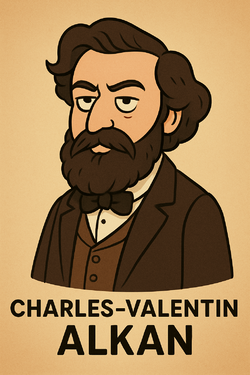
Charles-Valentin Alkan was a French composer, pianist, and teacher of Jewish descent, renowned as one of the greatest virtuoso pianists of the 19th century. A contemporary and close friend of Frédéric Chopin and Franz Liszt, he composed intensely complex and visionary works primarily for the piano, often exploring extreme technical demands and profound emotional depth.
Born in Paris, Alkan was a child prodigy, entering the Paris Conservatoire at age six. He achieved early fame as a pianist but gradually withdrew from public performance, leading a largely reclusive life focused on composition, study, and teaching. His music, largely neglected after his death, experienced a significant revival in the late 20th century, revealing works of immense originality and power.
- Alkan was famously reclusive, particularly after the 1840s. He refused prestigious positions, including the professorship of piano at the Paris Conservatoire after his teacher Zimmermann's death (reportedly saying 'Nobody here is worthy of teaching it, including myself') and allegedly declined the Légion d'honneur.
- His death is shrouded in legend, often attributed to him being crushed by a falling bookcase (or umbrella stand) while reaching for a volume of the Talmud from a high shelf. While plausible given his extensive library and solitary habits, the exact circumstances remain uncertain, documented primarily by his concierge's account reported in the press.
- Alkan composed numerous works with explicitly Jewish themes and titles (e.g., 'Siddur', 'Prières'), reflecting his deep connection to his heritage, which was unusual for major composers of the time in Western art music.
- He maintained close friendships with other major musical figures like Chopin, Liszt, Hiller, and Anton Rubinstein, and was admired by later composers including Busoni and Sorabji for his pianistic innovations.
- For decades after his death, Alkan's music was largely forgotten, considered unplayable and eccentric. A dedicated revival began in the mid-20th century, spearheaded by pianists like Raymond Lewenthal and Ronald Smith, establishing his reputation as a unique and significant voice in Romantic music.