Giuseppe Verdi: The Titan of Italian Opera
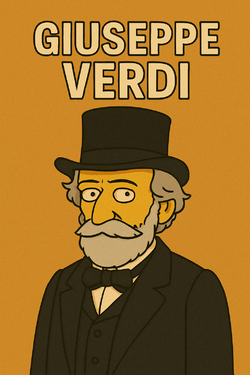
Giuseppe Verdi was an Italian composer of the Romantic era, widely regarded as one of the greatest opera composers of all time. His works, including masterpieces like 'Rigoletto', 'Il Trovatore', 'La Traviata', 'Aida', and 'Otello', dominated the 19th-century operatic stage and remain cornerstones of the repertoire today.
Born near Busseto, Italy, Verdi showed early musical talent. Overcoming personal tragedies and early career setbacks, his breakthrough came with 'Nabucco' (1842). He became a national icon, his music intertwined with the Italian unification movement (Risorgimento).
Composing prolifically through the mid-century ('Rigoletto', 'Il Trovatore', 'La Traviata' - the 'popular trilogy'), he later produced grander works like 'Aida' (1871). After a long retirement, he stunned the world with late masterpieces 'Otello' (1887) and 'Falstaff' (1893).
Verdi died in Milan, revered as a national treasure. His operas are celebrated for their profound melodies, dramatic power, and complex characterizations.
- His early opera 'Nabucco' featured the chorus 'Va, pensiero', which became an unofficial anthem of Italian patriotism and the Risorgimento movement.
- Verdi endured profound personal tragedy: his first wife, Margherita Barezzi, and their two infant children died within a short period (1838-1840), devastating him during the failure of his second opera.
- He lived with the soprano Giuseppina Strepponi (who sang in his early successes) for many years before marrying her in 1859, a relationship initially scandalous in conservative Italian society.
- Verdi was a wealthy landowner, deeply involved in managing his estate, Sant'Agata, near his birthplace. He often referred to himself as a 'farmer'.
- His 'Requiem' Mass (1874), composed in memory of the poet Alessandro Manzoni, is one of the most powerful and dramatic concert works of the 19th century, sometimes controversially described as 'an opera in ecclesiastical robes'.
- The cry 'Viva V.E.R.D.I!' was used by Italian patriots as a coded acronym for 'Viva Vittorio Emanuele Re D’Italia' (Long Live Victor Emmanuel, King of Italy), demonstrating how his name became synonymous with the nationalist cause.
- He died of a stroke in Milan. His funeral was immense and solemn; according to his wishes, it was simple and without music, yet the crowds spontaneously sang 'Va, pensiero' as his coffin was carried through the streets.