
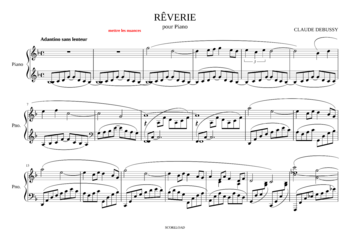




Claude Debussy's "Rêverie" is a beautiful and evocative piano piece composed in 1890. Here are some interesting facts about Debussy and "Rêverie":
Early Work: "Rêverie" was one of Debussy's earlier compositions, and it reflects his transition from the Romantic style of music to the Impressionist style for which he would become famous. It's considered a bridge between his earlier works and his later groundbreaking compositions.
Impressionist Music: Debussy is often associated with the Impressionist movement in music, characterized by its use of color, atmosphere, and suggestion rather than traditional harmonic and structural forms. "Rêverie" is an early example of his exploration of Impressionism.
Inspired by Paul Verlaine: The piece was originally written as a musical setting for a poem by the French Symbolist poet Paul Verlaine, titled "Rêverie." Although Debussy's composition is instrumental, it captures the dreamy and evocative qualities of Verlaine's poetry.
Notable Simplicity: "Rêverie" is known for its simplicity and lyrical beauty. It features a gentle, flowing melody with delicate, cascading arpeggios. The piece creates a tranquil and introspective mood, which is characteristic of much of Debussy's later work as well.
Popular with Pianists: "Rêverie" has remained a popular and frequently performed piece in the piano repertoire. Its accessibility and emotional depth make it a favorite among both pianists and audiences.
Debussy's Diverse Influence: Claude Debussy's innovative compositions, including "Rêverie," had a profound influence on 20th-century music. He paved the way for a more abstract and experimental approach to composition, inspiring composers like Ravel, Stravinsky, and many others.
Nocturne Variation: There is another version of "Rêverie" called "Rêverie, Nocturne" composed by Debussy, which is longer and more complex. It is sometimes referred to as "Rêverie No. 2." While the original "Rêverie" remains more popular, this variation offers a different perspective on the piece.
Significance in Debussy's Career: Although "Rêverie" may not be as famous as some of Debussy's later works like "Clair de Lune" or "Prelude to the Afternoon of a Faun," it played a crucial role in his development as a composer, showcasing his early experimentation with impressionistic techniques.
"Rêverie" is a timeless and enchanting piece that captures the essence of Debussy's unique musical language and serves as a delightful introduction to his works.




