Ludwig van Beethoven: The Revolutionary Composer Who Changed Music Forever
Early Life and Musical Beginnings
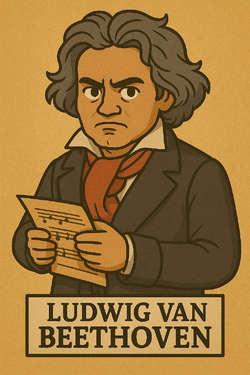
Ludwig van Beethoven was born in Bonn, Germany, into a musical family. His father, Johann van Beethoven, recognized his talent early and gave him rigorous training, hoping to mold him into a child prodigy like Mozart. By age 12, Beethoven published his first composition and served as assistant court organist. In 1792, he moved to Vienna to study with Haydn, rapidly gaining recognition as a virtuoso pianist renowned for his powerful improvisations.
Artistic Evolution and Major Works
Beethoven's career is divided into three creative periods. His early works (1795-1802) followed Classical traditions, featuring piano sonatas like 'Pathétique' and his First Symphony. The middle 'Heroic' period (1803-1814) produced groundbreaking compositions including the 'Eroica' Symphony (No. 3), Fifth Symphony's iconic 'fate motif', and the passionate 'Appassionata' Sonata. During this time, he created immortal pieces like 'Für Elise' and the 'Moonlight Sonata' - both among history's most recognized piano works.
Triumph Over Deafness
Around 1801, Beethoven began losing his hearing, a devastating development for a musician. He documented his despair in the 1802 Heiligenstadt Testament, contemplating suicide. Yet he persevered, declaring he would 'seize fate by the throat'. As his hearing deteriorated completely by 1818, Beethoven entered his late period (1815-1827), creating profoundly innovative works like the Ninth Symphony with its revolutionary choral finale 'Ode to Joy', and the transcendent Missa Solemnis.
Enduring Legacy and Influence
Beethoven revolutionized Western music by expanding forms, intensifying emotional expression, and elevating music's status as high art. His innovations include lengthening symphonies, increasing orchestra size, and pioneering cyclical motifs. Despite personal struggles including chronic illness and failed romances, he produced 9 symphonies, 32 piano sonatas, 16 string quartets, and the opera Fidelio. He died during a thunderstorm at 56, with 20,000 Viennese attending his funeral.
- Beethoven's 'Immortal Beloved' letters (1812) revealed agonizing unrequited love, but the recipient's identity remains debated among scholars.
- Contrary to legend, Beethoven never met Mozart - though the 17-year-old Beethoven traveled to Vienna hoping to study with him, returning to Bonn for his mother's funeral.
- During the 1806 premiere of his 'Razumovsky' Quartets, Beethoven snapped a violin string and tore the piano strings while playing.
- His final words were reportedly 'Plaudite, amici, comedia finita est' (Applaud, friends, the comedy is over), though accounts vary.