Edward Elgar: Master of British Romanticism
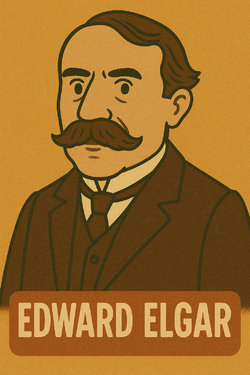
Edward Elgar was a preeminent English composer of the late Romantic era, celebrated for his orchestral works, oratorios, and songs, embodying the spirit of Edwardian Britain.
Largely self-taught, Elgar rose from humble origins as a provincial musician's son in Worcester to become the first internationally significant English composer since Purcell. His breakthrough came relatively late with the 'Enigma Variations' (1899). He achieved immense popularity with works like the 'Pomp and Circumstance Marches' (especially No. 1, containing 'Land of Hope and Glory'), the oratorio 'The Dream of Gerontius' (1900), and his Violin Concerto (1910) and Cello Concerto (1919). Knighted in 1904, he served as Master of the King's Musick (1924-1934). His music is characterized by rich orchestration, lyrical melodies, and a sense of nobility and nostalgia.
- Elgar's Roman Catholic faith in predominantly Protestant England presented social barriers early in his career.
- He achieved major recognition relatively late; the 'Enigma Variations' premiered when he was 42.
- His wife, Caroline Alice Elgar, was significantly older and from a higher social class; her unwavering support and management were crucial to his success.
- The central theme of the 'Enigma Variations' remains unidentified; Elgar took the secret of the 'enigma' to his grave, sparking endless speculation.
- He was deeply affected by World War I and the death of his wife in 1920, after which his creative output diminished significantly.
- He died from colorectal cancer at the age of 76.