Maurice Ravel: Master of Orchestration and Impressionism
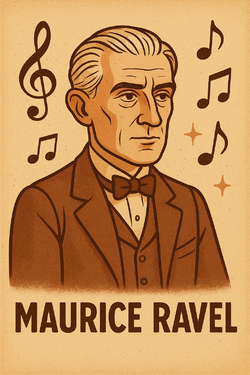
French composer renowned for his exceptional orchestration, pianistic brilliance, and association with musical Impressionism, though he often distanced himself from the label.
Born near the Spanish border in Ciboure, France, Ravel entered the Paris Conservatoire at 14. Despite early struggles for recognition and multiple Prix de Rome failures, he became a leading figure of his generation.
A member of the avant-garde 'Les Apaches', his meticulously crafted works include the 'Pavane pour une infante défunte', 'Jeux d'eau', 'Miroirs', 'Gaspard de la nuit', 'Daphnis et Chloé', 'Ma mère l'Oye', 'Le Tombeau de Couperin', 'La Valse', the famous 'Boléro', and his two piano concertos.
He served as a truck driver during WWI, profoundly affecting him. Later health issues, likely frontotemporal dementia, tragically halted his composing career.
- Ravel was notoriously private and never married. His small stature and meticulous nature earned him the nickname 'Ravel the Watchmaker'.
- His failure to win the Prix de Rome multiple times, despite being a leading young composer, caused a major scandal in 1905 (the 'Ravel Affair'), leading to the resignation of the Conservatoire director.
- During WWI, despite his age and small size, Ravel was determined to serve. He became a truck driver for the 13th Artillery Regiment, transporting shells under fire near Verdun, an experience that deeply scarred him.
- The incredible success of 'Boléro' (1928), a single extended crescendo based on two repeated melodies, became a double-edged sword, overshadowing his other works and frustrating him as he felt it contained 'no music'.
- Ravel declined the Légion d'Honneur in 1920, a rare act of refusal that caused another minor scandal.
- His final years were tragic. After a 1932 taxi accident, he developed aphasia and apraxia, likely a form of frontotemporal dementia (Pick's disease). He lost the ability to compose, write, or even play the piano, though his musical understanding remained. Brain surgery in 1937, hoping to alleviate his condition, was unsuccessful and led to his death.