Philip Glass
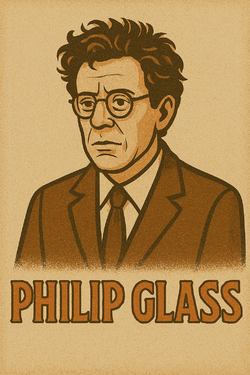
American composer and pianist, a pivotal figure in minimalism whose repetitive structures and harmonic innovations revolutionized contemporary classical music.
Born in Baltimore, studied at Juilliard and with Nadia Boulanger. Initially supported himself as a taxi driver and plumber while developing his signature style. Gained global recognition with the 1976 avant-garde opera 'Einstein on the Beach'. Prolific output includes symphonies, concertos, film scores (e.g., 'Koyaanisqatsi', 'The Hours'), and collaborations with artists like Allen Ginsberg and David Bowie.
- Rejected early acclaim when his 1969 piece 'Music with Changing Parts' caused a sensation in Europe; returned to New York to drive taxis and install dishwashers, deliberately avoiding the avant-garde elite.
- Founded the Philip Glass Ensemble (1968) to perform his rhythmically complex works, often using amplified keyboards and wind instruments, financing early recordings through loans and day jobs.
- His opera 'Einstein on the Beach' (co-created with Robert Wilson) broke conventions with its 5-hour runtime, abstract narrative, and lack of intermissions; audiences left/re-entered freely during premieres.
- Composed over 60 film scores, including three Oscar-nominated works ('Kundun', 'The Hours', 'Notes on a Scandal'), though he humorously lamented never winning: 'I’m always the bridesmaid.'
- Revealed in his memoir 'Words Without Music' (2015) that he studied mathematics at the University of Chicago and briefly considered becoming a sculptor before committing to composition.