
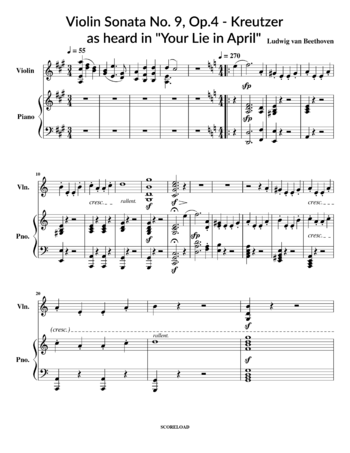
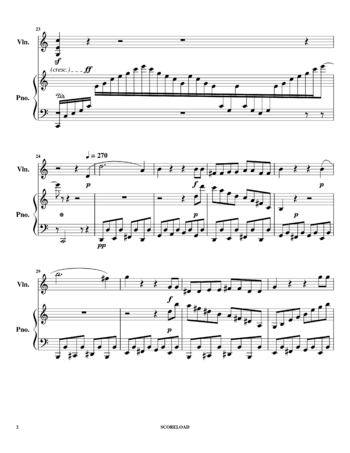




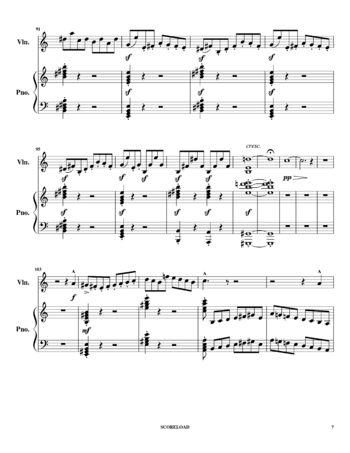

We have a collection of 4 arrangements for Ludwig van Beethoven - Violin Sonata No. 9, Op. 47 "Kreutzer"
How did Beethoven's "Kreutzer" Sonata become iconic in both classical music and anime culture? Learn!
The Violin Sonata No. 9 in A major, Op. 47, by Ludwig van Beethoven is also known as the "Kreutzer Sonata." Here are some interesting facts about this piece:
Dedication and Name: The sonata was originally dedicated to the French violinist George Bridgetower, who performed the piece with Beethoven in its premiere. However, their friendship soured, and Beethoven later changed the dedication to the famous French violinist Rodolphe Kreutzer, even though Kreutzer himself never performed or expressed any interest in the piece.
Complexity and Difficulty: The "Kreutzer Sonata" is known for its technical challenges, both for the violinist and the pianist. Beethoven pushed the boundaries of violin technique and explored the capabilities of the instrument, making it a demanding work to perform.
Three-Movement Structure: The sonata follows the traditional three-movement structure of fast-slow-fast. The movements are as follows:
Influence and Impact: The "Kreutzer Sonata" had a significant influence on later composers and performers. It played a role in shaping the Romantic violin repertoire, inspiring composers like Franz Liszt and Richard Wagner.
Literary Connection: The Russian writer Leo Tolstoy named one of his novellas "The Kreutzer Sonata" after Beethoven's piece. In Tolstoy's story, the sonata symbolizes themes of jealousy, passion, and conflict within a marriage.
Challenging Interpretation: The emotional intensity of the sonata requires careful interpretation by performers. Its shifting dynamics and contrasting moods demand a deep understanding of Beethoven's intentions and the ability to convey these emotions effectively.
Revolutionary Spirit: The "Kreutzer Sonata" is often associated with Beethoven's revolutionary spirit. Its passionate and dramatic character reflects the composer's departure from classical conventions and his willingness to explore new expressive territories.
Controversy and Reception: The sonata was initially met with mixed reactions from both audiences and critics. While some appreciated its innovative qualities, others found its emotional intensity and technical demands overwhelming.
Length and Duration: The "Kreutzer Sonata" is relatively long compared to other violin sonatas of the time. Its substantial length and complex structure contribute to its significance in the violin and chamber music repertoire.
Iconic Performers: Over the years, many renowned violinists and pianists have taken on the challenge of performing the "Kreutzer Sonata." It remains a cornerstone of the violin and piano repertoire, admired for its musical depth and technical brilliance.
The "Kreutzer Sonata" stands as a testament to Beethoven's innovation and ability to push the boundaries of musical expression, making it a timeless and captivating work in the classical music canon.







