Joseph Haydn
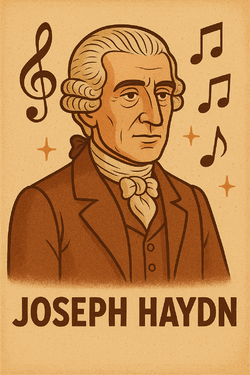
Austrian composer of the Classical era, known as the 'Father of the Symphony' and 'Father of the String Quartet'.
Haydn spent much of his career as a court musician for the Esterházy family, composing over 100 symphonies and 68 string quartets. His innovative work established the symphony and quartet as central Classical forms. Key compositions include the 'London' Symphonies, oratorios 'The Creation' and 'The Seasons', and the 'Emperor's Hymn' (basis for Germany's national anthem).
- As a child, Haydn's singing voice impressed Georg Reutter, who took him to Vienna's St. Stephen's Cathedral choir. At 17, he was dismissed after his voice broke and he cut off another chorister's pigtail.
- He worked almost 30 years for the Esterházys in rural isolation, later joking: 'I was cut off from the world... so I became original.' His 'Farewell' Symphony (No. 45) subtly protested Prince Nikolaus's refusal to let musicians visit families by having players exit stage during the finale.
- He developed close friendships with Mozart (who called him 'Papa Haydn') and taught Beethoven, though their relationship soured due to Beethoven's rebelliousness.
- During Napoleon's 1809 bombardment of Vienna, Haydn comforted servants by playing 'Emperor's Hymn' daily. He died days later; Napoleon posted guards at his funeral out of respect.