Pyotr Ilyich Tchaikovsky
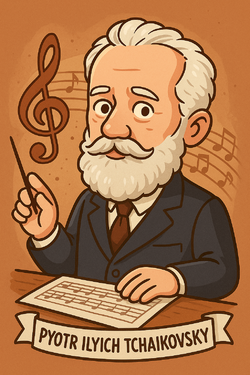
Pyotr Ilyich Tchaikovsky was a preeminent Russian composer of the Romantic era, renowned for his emotionally expressive and melodically rich orchestral works, ballets, operas, and chamber music.
Born in Votkinsk, Russia, Tchaikovsky initially trained for a career in civil service before studying music at the Saint Petersburg Conservatory. Despite personal struggles, including his concealed homosexuality and a disastrously brief marriage, he achieved immense national and international fame during his lifetime. He was financially supported for 13 years by Nadezhda von Meck, a wealthy patroness with whom he maintained a close but entirely epistolary relationship. Tchaikovsky composed some of the most popular works in the classical repertoire, including his ballets Swan Lake, The Sleeping Beauty, and The Nutcracker; the 1812 Overture; his First Piano Concerto; and his final three symphonies (Nos. 4, 5, and 6 "Pathétique"). His death in St. Petersburg shortly after conducting the premiere of the "Pathétique" Symphony remains a subject of speculation.
- Tchaikovsky struggled deeply with his homosexuality in the repressive social climate of Tsarist Russia. A disastrous marriage in 1877 to Antonina Miliukova, a former student who declared her love for him, lasted only a few weeks and caused him severe psychological distress, leading to a suicide attempt.
- His most significant financial and emotional support came from Nadezhda von Meck, a wealthy widow. For 13 years, she provided him with an annual stipend, allowing him to focus solely on composition. Their relationship was conducted entirely through letters; they deliberately never met in person.
- Tchaikovsky's death at age 53, officially attributed to cholera contracted from drinking unboiled water, is surrounded by controversy. An alternative, persistent theory suggests he was forced to commit suicide by a "court of honor" of his former schoolmates to avoid a scandal involving an alleged affair with a member of the Russian aristocracy. While widely discussed, conclusive evidence for this theory is lacking, and cholera remains the official cause.