Felix Mendelssohn
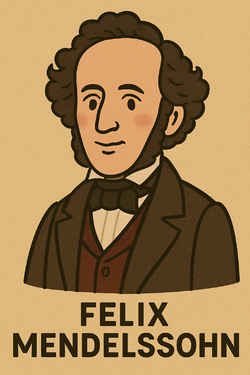
German composer, pianist, organist, conductor, and leading figure of the early Romantic period.
Born into a prominent Jewish family in Hamburg, Mendelssohn was a child prodigy. His family converted to Lutheranism, adding Bartholdy to their name. He achieved fame early with masterpieces like the Octet and the overture to 'A Midsummer Night's Dream'. He became a renowned conductor, notably reviving J.
S. Bach's 'St Matthew Passion' in 1829. He founded the Leipzig Conservatory. Prolific across symphonies, concertos, oratorios, chamber music, and songs, his life was cut short by a stroke at age 38, likely exacerbated by the death of his beloved sister Fanny.
- Mendelssohn was born Jewish but was baptized as a Reformed Christian at age seven; the family later adopted the surname Bartholdy.
- He was a remarkably gifted child prodigy, composing significant works like his String Octet in E-flat major (Op. 20) at age 16 and the overture to 'A Midsummer Night's Dream' at age 17.
- His 1829 revival of J.S. Bach's 'St Matthew Passion' in Berlin, after nearly 80 years of neglect, was a landmark event in the 'Bach revival' and cemented his reputation.
- He faced antisemitism throughout his life and posthumously, particularly intensified in Germany by Richard Wagner's infamous essay 'Das Judenthum in der Musik'.
- Mendelssohn was deeply devoted to his sister Fanny, also a highly talented composer. Her sudden death from a stroke in May 1847 devastated him; he suffered a series of strokes shortly after and died in November 1847 at age 38.